
Objective
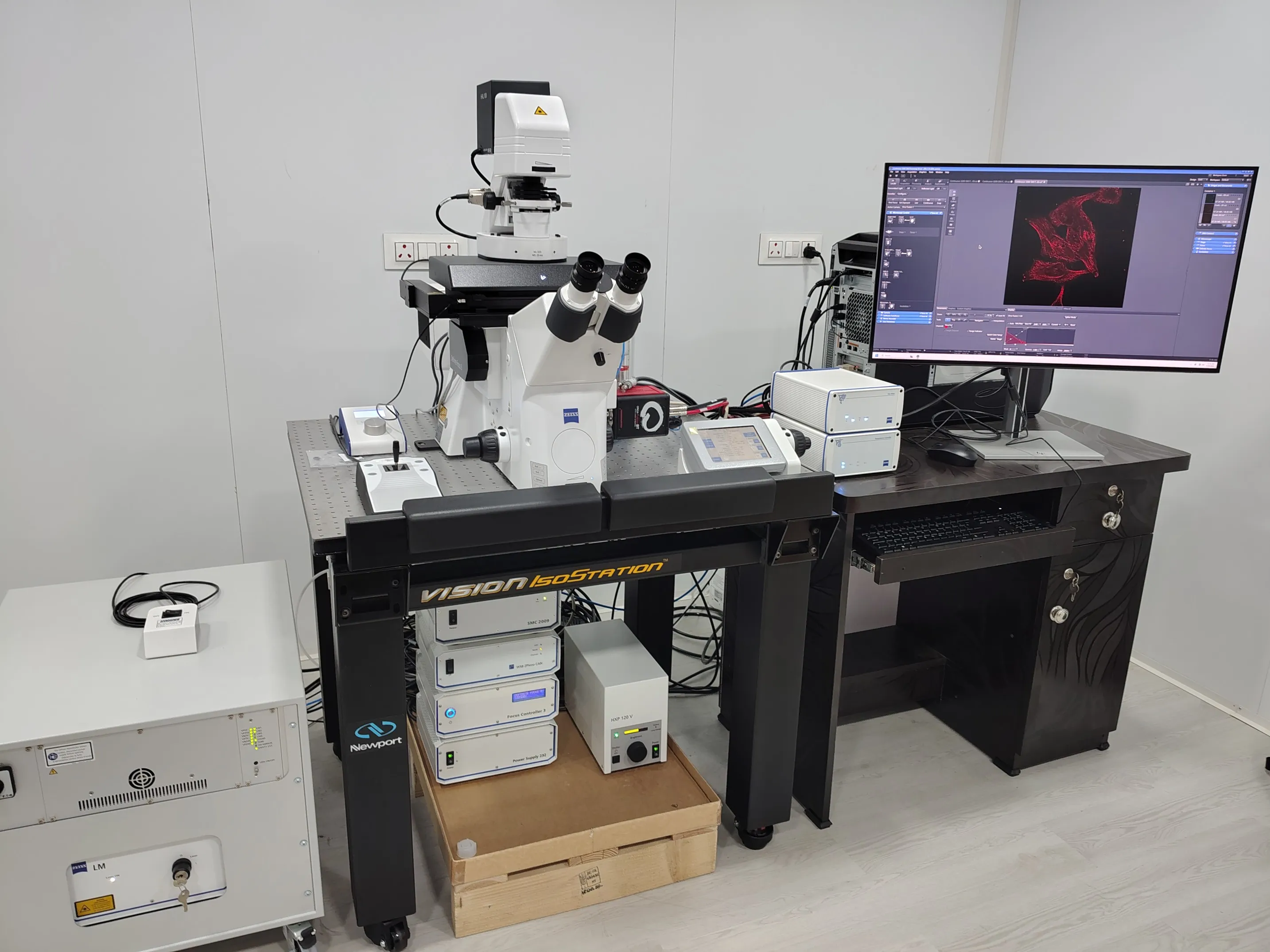
ZEISS Lattice SIM 5 :
The ZEISS Lattice SIM 5 is designed to
provide advanced super-resolution fluorescence imaging for visualization of
biological structures (both live and fixed samples) beyond the diffraction
limit of conventional light microscopy.
The system is designed to achieve
super-resolution imaging in the range of 60–120 nm, delivering enhanced
spatial resolution for detailed visualization of cellular structures. It enables
high-speed live-cell imaging while maintaining minimal phototoxicity, ensuring
cell viability during prolonged experiments. The platform provides
high-contrast optical sectioning along with advanced 3D imaging capabilities,
allowing precise visualization of complex biological samples. It supports long-term
imaging of dynamic
biological processes, making
it suitable for time-lapse and functional studies.
Additionally, the system facilitates multidisciplinary research across life
sciences and biomedical applications by integrating Widefield, Optical
Sectioning, and Structured Illumination Microscopy (SIM) imaging modes within a
single unified platform.
The system enables researchers to study
cellular architecture and molecular dynamics under physiologically relevant
conditions.
Leica STED STELLARIS :
The system enables super-resolution
imaging with an approximate resolution of 40–80 nm using Stimulated Emission
Depletion (STED) technology, allowing detailed visualization of subcellular and molecular architecture at the nanoscale level. It supports
multiplex fluorescence
imaging, making it suitable for studying complex biological systems with
multiple labelled targets simultaneously. The platform provides quantitative
imaging capabilities for precise molecular localization and interaction
analysis, enhancing the accuracy of biological investigations. Designed to
facilitate advanced research in cell biology, neuroscience, microbiology, and biomedical sciences, the system integrates both confocal and STED imaging modes within a single platform,
offering flexibility for a wide range of imaging applications.
Equipment & Details
EQUIPMENT 1 :
Instrument Name-ZEISS Lattice SIM 5
Manufacturer-ZEISS
EQUIPMENT 2 :
Instrument Name-Leica STED STELLARIS Super-Resolution Confocal Microscope
Manufacturer-Leica Microsystems
Sample Details
Utility and Working Principle
ZEISS Lattice SIM 5 :
In this technique, a structured lattice illumination pattern is projected onto the sample to enhance spatial information capture. Multiple images are acquired at different illumination phases and orientations, allowing high-frequency spatial details encoded within the illumination pattern to become detectable beyond the conventional diffraction limit. The collected raw data are then processed using advanced computational reconstruction based on the SIM² algorithm, which extracts and combines the encoded information. As a result, a super- resolution image is generated with improved contrast and approximately doubled spatial resolution compared to standard widefield microscopy.
Leica STED STELLARIS :
Stimulated Emission Depletion (STED)
microscopy enhances spatial
resolution by selectively depleting fluorescence
emission surrounding the focal excitation spot. In this technique, a focused excitation laser first excites
fluorophores within the sample, followed
immediately by a donut-shaped
STED depletion laser. The depletion beam forces fluorophores located at the
periphery back to the ground state through stimulated emission, effectively
restricting fluorescence emission to a nanoscale central region. By scanning
this minimized fluorescent spot across the sample, STED microscopy generates
super-resolved images with spatial resolution beyond the conventional
diffraction limit.